Events
Registration, tiers and payment, sessions, check-in and attendance.
An event is anything the organisation puts on: a meetup, training, webinar or conference, held online, in person or hybrid. Each carries a stable public reference used in its registration link, so renaming the event never breaks a link already in circulation.
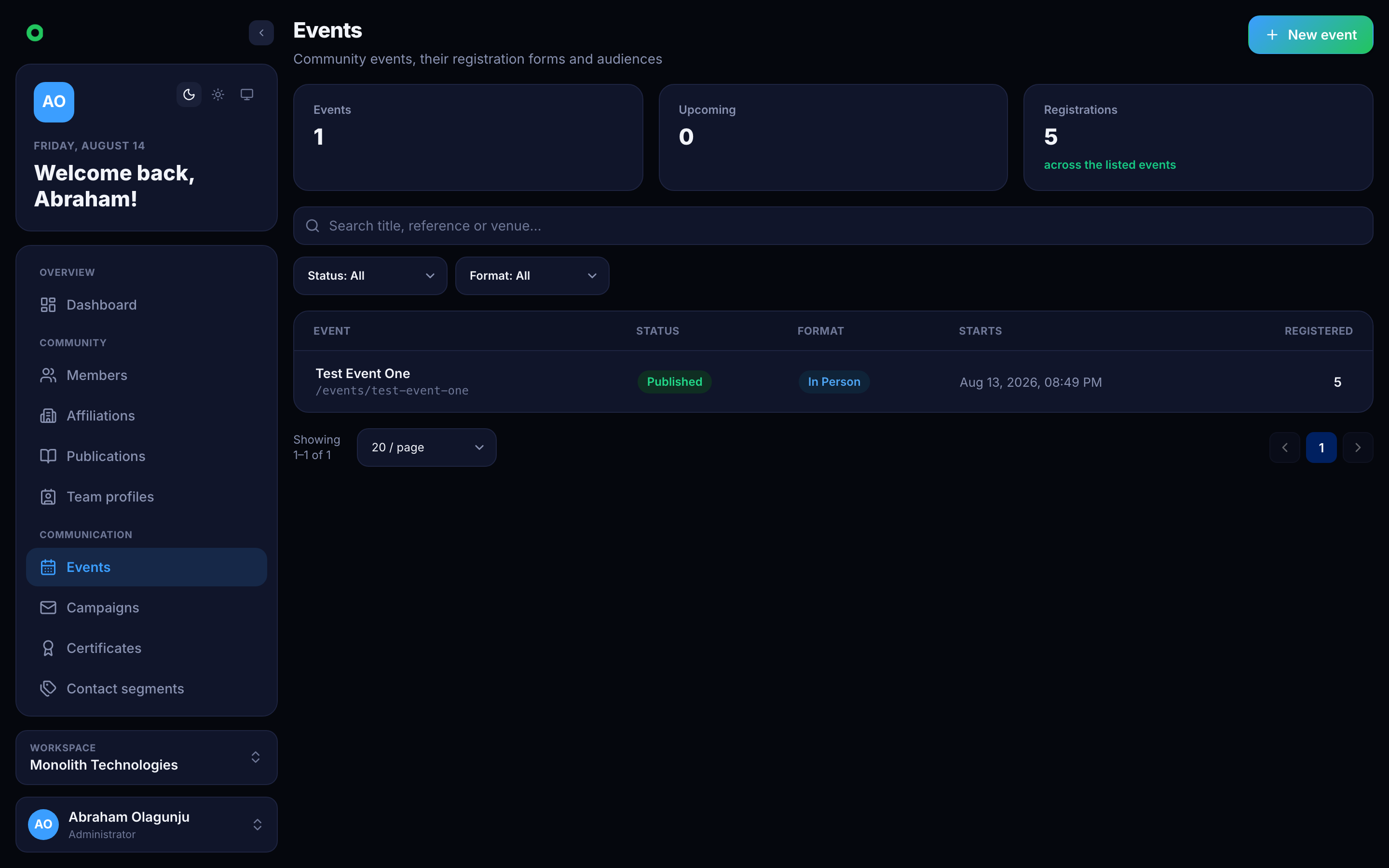
The shape of an event
- Status —
draft,published,cancelledorcompleted. Only a published event accepts registrations. - Format —
online,in-personorhybrid, which decides whether a venue, a meeting link, or both are shown. - Tiers — named admission types, each priced per currency. Free events skip them entirely.
- Sessions — a conference splits into sessions, each with its own window, so attendance is recorded per session rather than per event.
- Registration fields — extra questions asked at sign-up, defined per event.
Use cases
A free community meetup
Publish the event, share the registration link, and let people sign up. A
registration is registered immediately since payment is not-required. On the
day, check people in from the attendance screen.
A paid conference with tiers
Add tiers (Early bird, Standard, Student), each with prices in the currencies the
tenant has enabled. Registration is held at pending until payment reports
paid — an unpaid registration never counts toward capacity.
Registering people who signed up elsewhere
Registrations import from CSV the same way members do, so a list collected on another platform still lands in the attendance flow.
Check-in on the day
Attendance is recorded per session and per method, so a hybrid conference can distinguish someone who walked into the room from someone who joined the stream. Each check-in is stamped with a time.
Registrations and members are related, not identical
A registration captures a name, email and affiliation as typed on the day. When it matches a member it links to that record; when it does not, the registration still stands on its own. That is deliberate — a public event should not require membership, and cleaning strangers into the register is a separate decision.